How Lenders Calculate Debt-to-Income Ratio: What It Means and How to Improve Yours
When you're applying for a mortgage, one of the most important numbers lenders evaluate is your debt-to-income ratio (DTI). This percentage shows how much of your income goes toward paying monthly debts and helps lenders determine your ability to manage new obligations. Understanding how lenders calculate debt-to-income ratio—and how to optimize it—can significantly affect your loan approval, interest rates, and borrowing power.

For first-time homebuyers or anyone navigating the mortgage process, understanding DTI in the context of pre-approval is critical. Learn more about this process in our guide on how mortgage pre-approvals actually work and what can derail yours.
What Is Debt-to-Income Ratio?
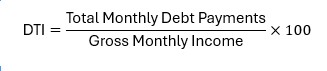
The debt-to-income ratio is a percentage that compares your total monthly debt payments to your gross monthly income. Lenders use DTI to evaluate financial health, ensuring you can handle a mortgage alongside existing obligations.
Formula:
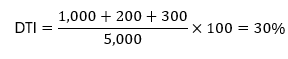
Example:
If your monthly debts include a $1,000 mortgage, $200 car loan, and $300 student loan, and your gross monthly income is $5,000:
Front-End vs Back-End DTI
Lenders consider two types of DTI:
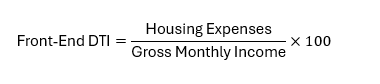
1. Front-End Ratio (Housing Ratio)
- Focuses on housing-related expenses: mortgage principal, interest, property taxes, homeowners insurance, and HOA fees.
Formula:
- Preferred range: 28–31%.
2. Back-End Ratio (Total Debt Ratio)
- Includes all monthly debts: housing, car loans, student loans, credit cards, personal loans, and recurring obligations.
Formula:
- Preferred range: 36–43%, with some flexibility for certain loan programs.
How Property Type Affects DTI
Your DTI can vary depending on the property type:
- Primary residence: Most flexible DTI limits.
- Second home: Slightly higher DTI allowed if you have strong credit or cash reserves.
- Investment property: Lower DTI and more reserves required due to higher risk.
For details, see our guide on the difference between primary residence, second home, and investment property for a mortgage application.
How Lenders Calculate Debt-to-Income Ratio
Lenders follow a systematic approach:
- Identify recurring monthly debts: Mortgage, car loans, student loans, credit cards, personal loans, child support, alimony, and other long-term obligations.
- Use gross monthly income: Includes pre-tax salary, bonuses, commissions, rental income, and alimony received.
- Adjust for debt types:
- Credit cards: typically minimum monthly payments.
- Deferred student loans: may be counted differently.
- Short-term or irregular debts: often excluded.
Using Debt Consolidation to Improve DTI
One of the most effective ways to improve your back-end DTI is through debt consolidation. Combining multiple smaller debts into a single loan can lower monthly obligations, reduce interest, and simplify repayment.
Learn more in our guide on how debt consolidation loans work: a beginner's guide to paying off debt smarter.
Benefits of consolidation:
- Lower monthly payments reduce back-end DTI.
- Combine multiple high-interest debts into a lower-rate loan, saving money.
- Easier management reduces the risk of missed payments.
Creating a Debt Payoff Plan
Structured repayment plans can systematically reduce DTI. Approaches like the snowball or avalanche method are effective:
- Snowball: Pay off smallest debts first to build momentum.
- Avalanche: Focus on high-interest debts first to minimize interest paid.
Each payoff reduces monthly obligations, lowering back-end DTI.
Learn more in how to create a debt payoff plan: snowball vs avalanche.
Strategies to Improve Your Debt-to-Income Ratio
Beyond consolidation and payoff plans:
- Pay down high-interest debts first
- Increase your income through side jobs or rental income
- Avoid new debt before applying
- Negotiate lower minimum payments
- Exclude non-recurring debts like medical bills or temporary obligations
Maximum DTI Ratios by Loan Type
| Loan Type | Front-End Max | Back-End Max | Notes |
|---|---|---|---|
| Conventional | 28–31% | 36–43% | Flexible with strong credit/reserves |
| FHA | 31% | 43–50% | More lenient for moderate income |
| VA | 41% | 41% | Front-end limit not strict, total DTI matters |
| USDA | 29% | 41% | Must meet income limits and property eligibility |
Real-Life Examples of Improving DTI
| Scenario | Current DTI | Strategy | Resulting DTI |
|---|---|---|---|
| Credit card consolidation | 45% | Combine 3 cards into 1 lower-payment loan | 38% |
| Snowball payoff plan | 42% | Pay off $200/month small debts first | 36% |
| Side income addition | 40% | $500/month rental income | 36% |
Why Optimizing Your DTI Matters
- Improves mortgage approval chances
- Can result in lower interest rates
- May allow higher loan amounts
- Demonstrates financial stability to lenders
Even small reductions, like lowering back-end DTI from 45% to 38%, can be the difference between denial and approval.
Takeaways and Next Steps
Understanding how lenders calculate debt-to-income ratio and actively managing your DTI gives you a significant advantage in mortgage applications. Focus on paying down debts, consolidating when possible, following structured payoff plans, increasing income, and avoiding new obligations before applying.
If debt or DTI is a concern for your mortgage pre-approval, speaking with a Bluefield Mortgage Group specialist can provide personalized strategies. They can review your financial profile, suggest ways to improve your DTI, and help you navigate lender requirements to increase your chances of approval.
Frequently Asked Questions About DTI:
What is a good debt-to-income ratio for a mortgage?
Front-end ≤ 31%, back-end ≤ 43%, though FHA and other programs allow higher.
Can paying off credit cards improve my DTI quickly?
Yes, reducing monthly obligations lowers back-end DTI immediately.
How do lenders treat student loans in DTI?
Deferred loans may be counted differently; often 1% of the balance if no payment is required.
Front-end: housing costs only.
Back-end: all monthly debt obligations combined.