

The South Carolina Eviction Process: A Step-by-Step Guide for Landlords
Owning rental property in South Carolina can be a great investment, but it also comes with legal responsibilities—especially when a tenant stops paying rent or violates the lease. Whether you’re a first-time landlord or an experienced real estate investor, understanding the South Carolina eviction process is essential to protecting your property and avoiding costly legal mistakes.
In this guide, we’ll walk through the eviction process step-by-step under the South Carolina Residential Landlord and Tenant Act, explaining the required notices, court procedures, and timelines that landlords must follow. If you own rental property in South Carolina, knowing these rules can help you handle difficult tenant situations while staying compliant with state law.
⚠️ NOTE: Before we begin, it’s worth noting that this article is for general informational purposes only and is not legal advice. Landlords should consult with an attorney for advice on a specific eviction matter.
What Is the Legal Basis for Eviction in South Carolina?
Under S.C. Code § 27-37-10(A), a tenant may be ejected when the tenant:
- fails or refuses to pay rent when due or when demanded,
- stays after the term of tenancy or occupancy has ended, or
- violates the terms or conditions of the lease.
That means the most common grounds for eviction in South Carolina are:
- nonpayment of rent,
- lease violations,
- holdover tenancy after lease expiration, and
- certain health and safety violations covered by the Landlord and Tenant Act.
Step 1: Identify the Reason for the Eviction
The first step is determining why the tenancy is being terminated, because the required notice depends on the nature of the default.
For lease violations other than nonpayment of rent, S.C. Code § 27-40-710(A) allows the landlord to deliver written notice specifying the breach and stating that the rental agreement will terminate on a date not less than 14 days after receipt of the notice if the breach is not remedied within that time. The statute also says the lease does not terminate if the tenant cures the breach within that period, or if the cure cannot be completed within 14 days but is started in that period and pursued in good faith to completion within a reasonable time.
For nonpayment of rent, S.C. Code § 27-40-710(B) provides a different rule: if rent is unpaid when due and the tenant fails to pay within five days from the date due, the landlord may terminate the rental agreement, provided the landlord has given the required written notice.
Step 2: Serve the Required Notice
Five-Day Notice for Nonpayment of Rent
For unpaid rent, South Carolina law generally requires written notice of nonpayment and the landlord’s intent to terminate if the rent is not paid within the five-day period.
However, the statute gives landlords an important shortcut. Under § 27-40-710(B), the written-notice requirement is considered satisfied if the lease contains this notice, or something substantially equivalent to it:
“IF YOU DO NOT PAY YOUR RENT ON TIME: This is your notice. If you do not pay your rent within five days of the due date, the landlord can start to have you evicted. You will get no other notice as long as you live in this rental unit.”
The ejectment chapter reinforces that rule. § 27-37-10(B) states that, for residential rental agreements, nonpayment of rent within five days of the due date constitutes legal notice if the written rental agreement contains the required bold, conspicuous language.
Fourteen-Day Notice for Other Lease Violations
If the problem is something other than unpaid rent, such as an unauthorized occupant, unauthorized pet, or another lease violation, the landlord generally must give a 14-day notice to cure or quit under § 27-40-710(A). The notice should clearly describe the violation and state that the lease will terminate if the violation is not corrected within 14 days.
Health and Safety Violations
South Carolina also addresses certain tenant conduct affecting health and safety. Under § 27-40-720, if the tenant fails to comply with obligations materially affecting health and safety, the landlord may have remedies that include notice and termination depending on the circumstances.
Step 3: File the Eviction in Magistrate Court
If the tenant does not cure the breach or vacate after proper notice, the landlord typically proceeds by filing an ejectment action in Magistrate Court.
Under S.C. Code § 27-37-20, once the landlord, agent, or attorney applies, the magistrate issues a written rule requiring the tenant either to vacate or to show cause why they should not be ejected within ten days after service of the rule. This is the formal beginning of the court eviction case.
Step 4: Service of the Rule to Vacate or Show Cause
The tenant must be properly served. S.C. Code § 27-37-30 explains how service works. The rule may be served in the same manner as other court process, and the statute also provides alternative service procedures in certain circumstances. For example, if service attempts are unsuccessful, the statute lays out a posting-and-mailing process and explains when service is deemed complete. It also states that, in that situation, the tenant’s time to respond begins running on the eleventh day after mailing, unless the tenant contacts the court earlier.
Landlords need to be careful with timing: the “ten-day” window of opportunity for the tenant to request a hearing is tied to the date they were served, not the date of the filing.
Step 5: The Tenant's Opportunity to Dispute
Under § 27-37-20, the tenant has ten days after service to vacate or show cause why the eviction should not proceed.
If the tenant does not respond within that period, § 27-37-40 says the magistrate shall issue a warrant of ejectment, and the tenant is removed by the constable or sheriff.
If the tenant does appear and contest the eviction, § 27-37-60 provides that the magistrate shall hear and determine the case as any other civil case. Either party may also demand a jury trial under § 27-37-80.
Step 6: The Court Hearing
If the case is contested by the tenant, the magistrate judge (or the jury) hears the evidence and decides whether the landlord is entitled to possession. At that stage, the landlord typically needs to prove:
- the lease existed,
- the tenant defaulted or violated the lease,
- the required statutory notice was properly given, and
- the tenant failed to cure or vacate as required.
Tenants may raise defenses. South Carolina law expressly allows tenants, in some possession actions, to assert defenses and counterclaims based on the rental agreement or the Landlord and Tenant Act. For example, § 27-40-640 addresses a tenant’s ability to raise certain landlord noncompliance issues as defenses or counterclaims, though that section also contains limitations.
This is just one of many reasons why it's important for landlords to diligently follow all aspects of the law and their obligations under the lease. Failure to adhere to the requirements of the statute, or defaulting on a term of the lease, can make it more difficult to regain possession of the property through an eviction if the tenant stops paying rent.
Step 7: Judgment, Writ, and Removal
If the landlord wins, the next step depends on how the case was resolved. If the tenant fails to appear and show cause, § 27-37-40 authorizes issuance of a warrant of ejectment. If the matter is tried and the verdict is for the landlord, § 27-37-100 states that the magistrate shall issue a writ of ejectment within five days, and the tenant is then ejected by the constable or sheriff.
That last part is important: the actual physical removal is carried out by law enforcement, not by the landlord personally. South Carolina law does not permit a landlord to simply change locks, shut off utilities, or otherwise force a tenant out outside the lawful process. § 27-40-760 limits a landlord’s ability to recover possession except in cases such as abandonment, surrender, termination, or as otherwise permitted by the chapter, and § 27-40-660 gives tenants remedies for unlawful ouster or exclusion.
What Happens to the Tenant’s Property?
South Carolina has a specific rule for personal property removed during an eviction. Under § 27-40-710(D), personal property removed from the premises and placed on a public street or highway is to be removed by the appropriate municipal or county officials after 48 hours, excluding Saturdays, Sundays, and holidays. If the property is in a municipality or county that does not collect such debris from public highways, then after that 48-hour period, the landlord may remove and dispose of it as trash or debris is normally handled there. The statute also says that the notice of eviction must clearly inform the tenant of these provisions, which means landlords should be cautious and make sure their eviction paperwork and process align with the statute before disposing of any belongings.
Rent Continues to Accrue During the Case
Another point many landlords overlook is that rent does not necessarily stop accruing just because the eviction case has been filed. Under § 27-37-150, once ejectment proceedings begin through the issuance of the rule to vacate or show cause, rent for use and occupancy continues to accrue as long as the tenant remains in possession, at the same rate as before. The statute also states that accepting rent after filing does not automatically waive the landlord’s right to continue pursuing ejectment.
Step 8: Appeals and Stays
Either party may appeal an ejectment case under § 27-37-120, but an appeal does not automatically stop the eviction. Under § 27-37-130, ejectment is not stayed unless the tenant gives an appeal bond in the amount fixed by the magistrate, and if the tenant fails to file that bond within five days after service of the notice of appeal, the appeal is dismissed by the trial magistrate.
What Landlords Should Not Do
Landlords should avoid any type of “self-help” eviction. In South Carolina, unlawful lockouts and intentional interruption of essential services can expose a landlord to significant liability. Under § 27-40-660, a tenant who is unlawfully removed or excluded, or whose essential services are willfully interrupted, may recover possession or terminate the lease and recover the greater of three months’ rent or twice actual damages, plus reasonable attorney’s fees. For that reason, even when a tenant is clearly in default, landlords should follow the statutory process carefully and document each step.
How Long Does the Eviction Process Take in South Carolina?
There is no single fixed timeline for every case, but the statutory deadlines give a general framework:
- A "cure notice" period of five days from the due date for nonpayment cases, or 14 days for other lease violations, plus
- the amount of time needed for the tenant to be properly served, plus
- a 10-day window after service for the tenant to request a hearing, plus
- the amount of time for a court date to be scheduled by the magistrate, plus
- five days after a verdict for the magistrate to issue the writ of ejectment, plus
- the amount of time needed for the sheriff or constable to schedule the "set out."
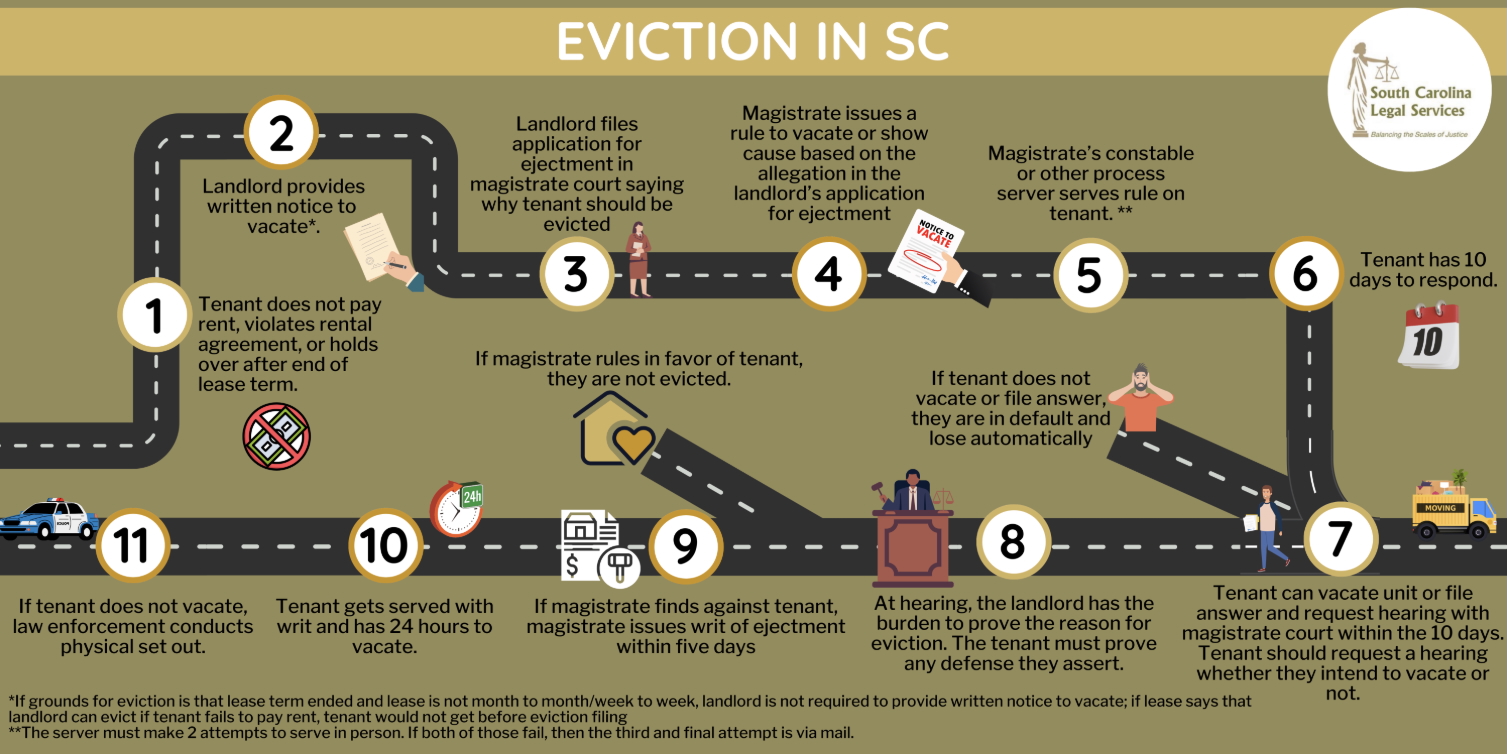
In practice, the full timeline depends on how long it takes for service of the tenant, whether the tenant contests the case, court scheduling, and sheriff or constable availability. This is why some South Carolina evictions move fairly quickly, while others take longer. Here's a great visual representation of the process, courtesy of South Carolina Legal Services:
Final Thoughts
The South Carolina eviction process is straightforward in concept, but detail-heavy in practice. A landlord usually must:
- identify the legal basis for termination,
- give the correct notice,
- file an ejectment action in Magistrate Court,
- ensure proper service,
- wait through the tenant’s response period,
- attend the hearing if contested, and
- rely on the sheriff or constable to complete the removal if the landlord prevails.
For landlords, the biggest mistakes are usually procedural: using the wrong notice, filing too early, miscalculating service deadlines, or attempting self-help measures. For that reason, many owners choose to work with an experienced South Carolina property management company to handle notices, filing, court coordination, and compliance. If you're interested in learning more, check out this breakdown of our various Property Management options, which includes a transparent breakdown of our pricing structure.